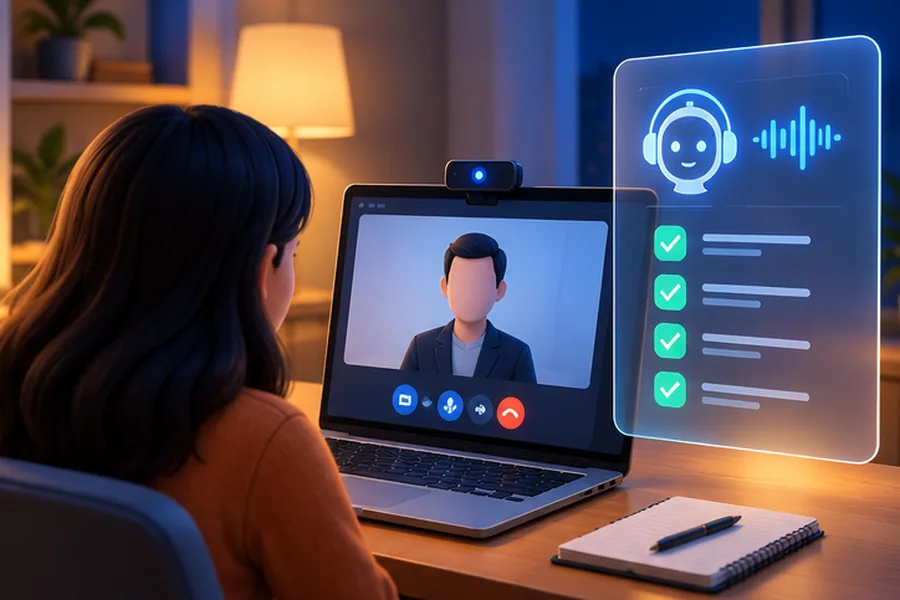
- AI now shows up at five points in hiring: resume ranking, async video interviews, AI voice or chat interviewers, AI-proctored coding tests, and (in a few places) rounds where you are allowed to use AI.
- Most AI-scored formats work mainly from what you say and write (transcripts, code, answers). Clear, structured, specific content matters most.
- For coding tests, AI proctoring flags tab switches, extra people or devices, paste patterns and code similarity. Follow the rules exactly.
- A human usually still makes the final hiring decision, but AI increasingly decides who reaches that human.
- Prepare like this: structured answers, recorded practice, a clean technical setup, an ATS-friendly resume, and honest work.
A few years ago, the first person to evaluate your application was a recruiter. Today, for many roles in India, especially high-volume fresher and early-career hiring, it is quite likely to be software: a system ranking your resume, a platform scoring your recorded video answers, an AI voice agent asking screening questions, or a proctoring system watching your webcam during an online assessment.
This guide explains how those stages generally work, what they evaluate, and how to prepare for each one. One caution: hiring tools and company processes change every season, and vendors don't publish exactly how their models score candidates. What follows describes commonly reported practice and how these systems generally work. Always read the instructions for your specific assessment, and check recent candidate experiences for the company.
Where AI Shows Up in the Hiring Funnel
| Stage | What AI does | Common in | Who decides |
|---|---|---|---|
| Resume screening | Parses resumes, matches to job description, ranks or filters | Almost all mid-to-large employers via ATS; AI ranking increasingly common | Mostly recruiters, with AI ordering the queue |
| Recruiter chat / scheduling | Chatbots answer FAQs, collect details, schedule interviews | High-volume hiring, campus drives | Logistics only |
| Async video interview | You record answers; transcripts and content are assessed, often with AI assistance | Services companies, GCCs, graduate programmes, non-tech roles | Recruiters, often helped by AI scores or summaries |
| AI voice / chat interviewer | An AI agent asks questions live and asks follow-ups | Growing for first-round screens, especially at startups and high-volume roles | Recruiters review AI-generated reports |
| Online coding assessment | Auto-graded tests plus AI proctoring and plagiarism detection | Very common: services, product companies, campus | Score thresholds plus human review of flags |
| Live interviews | AI note-taking or summaries for human interviewers; some AI-allowed coding formats | Some companies | Human interviewers |
Each stage rewards something slightly different, so prepare for them separately.
Stage 1: AI Resume Screening and ATS
An applicant tracking system (ATS) such as Workday, Greenhouse, Lever or SuccessFactors stores applications and lets recruiters search and filter them. Many ATS products and add-ons now include AI features that score how well your resume matches a job description, summarise your profile, or rank applicants. Job portals like Naukri and LinkedIn also rank you in recruiter searches.
What actually gets you filtered out
- Knockout questions. Notice period, location, work authorisation, minimum qualification, years of experience. These are the most common source of truly automatic rejection. Answer honestly, but read them carefully.
- Parsing failures. Two-column layouts, text inside images or tables, headers and footers, and unusual fonts can come out garbled when parsed. A recruiter searching for "Kafka" won't find you if the parser lost that line.
- Weak match to the job description. If the role asks for Spring Boot and microservices and your resume says "backend development" without naming tools, both keyword search and semantic matching rank you lower.
How to prepare
- Use a simple, single-column format with standard headings (Experience, Projects, Skills, Education), exported as a text-based PDF. Check by copying all the text from your PDF into a plain text editor: if it comes out jumbled, a parser will struggle too.
- Mirror the job description's language honestly. If you have used PostgreSQL, write "PostgreSQL", not just "SQL databases". Put relevant skills in context ("built REST APIs in Spring Boot handling ~2 lakh requests/day"), not only in a skills list.
- Don't keyword-stuff. Hidden white text and copied job descriptions are an old trick. Modern systems and the recruiters who read the resume afterwards both treat them as red flags.
- Keep job portals fresh. Recruiters often filter Naukri and LinkedIn by recently active profiles. See Naukri profile optimisation and the software engineer resume guide.
Stage 2: Async (One-Way) Video Interviews
In an async video interview, you log in to a platform (HireVue is the best-known vendor, and there are many others, including Indian ones), see a question on screen, get a short preparation time, and record an answer within a fixed limit, often 1–3 minutes. Sometimes you get one retake; often you don't. Recruiters review the recordings later, increasingly with AI-generated transcripts, summaries or scores.
What is evaluated
Scoring methods are not public and vary by vendor and employer. The industry has generally moved away from analysing facial expressions; HireVue, for example, publicly announced in 2021 that it had stopped using facial analysis. What remains is mostly what you say: the transcript, assessed against competencies the employer defined (communication, problem solving, ownership, customer focus). Practically, that means:
- Relevance: did you answer the actual question?
- Structure: situation, action, result; clear points.
- Specificity: concrete examples, numbers and technologies rather than generic statements.
- Clarity: audible, steady, complete sentences that transcribe cleanly.
Typical questions for software roles
- Introduce yourself and your current role (see how to answer "tell me about yourself").
- Describe a technical project you are proud of and your role in it.
- Tell us about a time you had to learn a new technology quickly.
- Describe a time you disagreed with a teammate. How did you resolve it?
- Explain a technical concept (for example, what an API is, or how indexing helps) to a non-technical person.
- Why do you want to join our company?
Answer technique for a 2-minute recorded answer
| Segment | Time | Content |
|---|---|---|
| Direct answer | 10–15 s | One-sentence answer to the question asked |
| Situation & task | 20–25 s | Context: where, what system, what was at stake |
| Actions | 45–60 s | 2–3 specific things you did, with the reasoning |
| Result & learning | 20–25 s | A number or concrete outcome, plus one learning |
Practical tips: look at the camera lens, not your own image. Use a plain background and light facing you. Use earphones with a mic if your room echoes. Keep a few bullet-point notes just below the camera if allowed, but never read a full script, because it sounds flat and the reading shows. Practise by recording yourself on your phone with a timer; most people discover they need the first 30 seconds just to get to the point.
Stage 3: AI Voice and Chat Interviewers
The newest format is a live conversation with an AI interviewer, by voice or text, that asks screening questions and, unlike a one-way video, asks follow-ups based on your answers. Afterwards, the recruiter usually receives a transcript and a structured report. Several startups sell these tools, and they are being adopted for first-round screens where human recruiters can't keep up with volume.
What these rounds cover for engineers
- Resume verification: "You mentioned Kafka. What did you use it for, and what was the partitioning strategy?"
- Conceptual technical questions: difference between a process and a thread, SQL vs NoSQL trade-offs, how HTTPS works, REST principles.
- Situational and behavioural questions, with probing follow-ups.
- Logistics: notice period, current and expected CTC, location preference.
How to do well
- Expect drilling on your resume. These systems are good at turning each line of your resume into a follow-up question. Every technology you list should survive "how did you use it, and what problem did it solve?" The 30 follow-ups in how to explain projects in an interview are excellent practice.
- Answer in complete, self-contained sentences. Transcripts are what get read. "Yes, so basically that thing we did" is meaningless in a report; "We used Kafka to decouple order placement from invoice generation" is clear.
- Pause before answering. Some systems treat long silences as the end of your answer. If you need a moment, say "Let me think about that for a second."
- Clarify when unclear. "Could you repeat the question?" or "Do you mean in my current project or in general?" Most systems handle this fine.
- Stay human. Talk as you would to a recruiter: concise and specific, with neither a monologue nor one-word answers.
Practise with a general AI assistant in voice mode: paste your resume and ask it to screen you with follow-ups. The prompts in how to use AI tools for interview preparation work well for this.
Stage 4: AI-Proctored Online Coding Assessments
Online assessments (OAs) on platforms such as HackerRank, HackerEarth, Codility, CodeSignal, Mercer Mettl and iMocha are standard for both campus and lateral hiring in India. Your code is auto-graded against hidden test cases. Increasingly, the session is also remotely proctored, with AI flagging suspicious behaviour for human review.
What proctoring typically monitors
| Signal | Example flags |
|---|---|
| Browser activity | Switching tabs or windows, leaving full-screen, copy-paste into the editor |
| Webcam | Face not visible, multiple faces, looking away for long periods, phone in view |
| Audio | Other voices, someone dictating |
| Code analysis | High similarity to other candidates' submissions, to known online solutions, or to typical AI-generated code; sudden large pastes |
| Identity | ID check mismatch, different person across sessions |
The exact signals differ by platform and by how the employer configures the test. Flags are typically reviewed rather than acted on blindly, but a flagged test can lead to disqualification. Some companies also re-check you later: a live round that asks you to explain or extend your OA solution quickly exposes code you didn't write.
How to prepare
- Practise on the actual platform. Most platforms have a practice test or sample environment. Learn how input/output works, which languages and versions are available, and how custom test cases run.
- Prepare your environment. Clear desk, closed apps, notifications off, phone out of view (unless it is required for a secondary camera), stable internet with a hotspot backup, charger plugged in.
- Read the rules on rough work. Some tests allow pen and paper, others don't. If unsure, ask the recruiter beforehand.
- Type your code, don't paste it. Even pasting your own snippet from a notes file can trigger a flag.
- Handle disruptions transparently. If your power or internet fails, take a screenshot or note the time and email the recruiter immediately.
Strategy for the test itself (partial scores, reading constraints, time allocation across questions) is covered in online assessment tips for HackerRank and Codility and, for Amazon specifically, the Amazon OA guide.
Stage 5: Rounds Where You Are Allowed to Use AI
The opposite trend is also emerging. Since engineers use AI coding assistants at work every day (see Cursor, Claude Code and Copilot compared), some companies are testing interview formats where an AI assistant is available inside the coding environment, and the interviewer watches how you use it. Some assessment platforms have added this as an option, and there have been media reports of large tech companies piloting AI-enabled coding interviews. It remains a minority format. Most interviews in 2026 still prohibit AI, so treat this as something to be ready for, not something to expect.
What is evaluated when AI is allowed
- Problem decomposition: do you plan the solution, or just paste the prompt into the assistant?
- Prompting and context: do you give the assistant precise, scoped tasks?
- Verification: do you read, test and question generated code, or accept it blindly? This is the biggest differentiator.
- Debugging: when generated code fails, can you find out why?
- Judgement: do you know when it is faster to write it yourself?
Preparation: build a small project end to end with an AI assistant while deliberately reviewing every diff. Practise explaining aloud why you accepted or rejected a suggestion. The fundamentals still decide the result, because you can't verify code you don't understand. The wider effect of AI on early-career hiring is discussed in AI coding assistants and junior developer hiring.
Integrity: What Gets Flagged and Why It Isn't Worth It
There is a market for "interview help" tools that overlay AI answers on your screen during live interviews or feed you answers through hidden devices. Beyond the ethics, this is a bad bet:
- Detection is improving on both sides. Proctoring flags unusual eye movement, delays before fluent answers, and code that doesn't match your typing pattern. Human interviewers increasingly ask you to explain a line or change a requirement mid-way, which exposes answers you don't understand.
- Consequences last. Disqualification is the mild outcome. Many companies record integrity violations and may bar you from reapplying. Offers can be withdrawn if misrepresentation is discovered later, including during background verification.
- The job still has to be done. Getting into a role you can't perform leads to a failed probation, which is harder to explain than a rejected interview. See probation periods in Indian IT.
Fairness, Data and Your Rights as a Candidate
AI screening raises real concerns: bias against accents, disabilities or non-standard career paths; opaque rejections; and the handling of your video, voice and ID data. A few practical points:
- Data protection. India's Digital Personal Data Protection Act, 2023 sets out consent-based rules for processing personal data, with implementing rules being phased in. You can reasonably ask an employer or platform how your recordings are used and how long they are kept. Read the consent screen before you click through.
- Accommodations. If you have a speech, hearing, visual or other disability, or a situation such as an unreliable internet connection, ask the recruiter about an alternative format before the assessment. Many employers can extend time or offer a human interviewer.
- Accent and language. Speech-to-text has improved for Indian English accents but isn't perfect. Speaking slightly slower and enunciating technical terms ("Postgres", "Kubernetes") helps transcription accuracy more than trying to change your accent.
- Feedback. Automated rejections rarely come with reasons. If you reached a human stage, it is fair to ask for brief feedback, though many companies' policies don't allow it.
Your AI-Interview Prep Checklist
Parseable and matched
Single column, standard headings, text-based PDF; mirror the job description's tools honestly; every listed skill defensible in a follow-up.
6 structured answers
Introduction, flagship project, learning fast, disagreement, failure, why this company, each about 2 minutes, direct answer first.
Record and review
Five recorded answers on your phone with a timer; one AI voice mock grilling your resume; one human mock.
OA readiness
Practice test on the platform; your language's I/O; timed sets of 2 problems in 90 minutes; core CS concepts revised.
Clean environment
Light in front, quiet room, earphones with mic, charger, backup internet, apps closed, phone away.
Read the rules
Know what is allowed (paper, IDE, AI). Ask in writing if unclear. Report disruptions immediately.
AI hasn't changed what companies want: engineers who understand fundamentals, can explain their work clearly, and can be trusted. It has changed how early and how often you are tested on those things. Candidates who prepare structured, specific, honest answers and solid fundamentals do well whether the first interviewer is a person or a program.
Frequently Asked Questions
Prepare for Every Kind of Round
Whether the first round is an AI screen or a human interviewer, Prepflix trains the fundamentals and communication that pass both.
Explore the Prepflix Course →